Are You Addicted to Stress? What Your Nervous System Is Really Trying To Tell You
Have you noticed how you thrive on chaos, long to-do lists and stress?
You keep taking on more work, chores and favours for other people, and somehow it makes you feel motivated, keeping busy feels good. It feels productive and it feels safe.
But it leaves little room for rest, and some days you feel so overwhelmed you don't know what to do with yourself. You don't feel present with your loved ones and you have no time for hobbies or self care. The things you used to enjoy start to feel like luxuries you need to earn.
When you see it written like that, it doesn't sound very healthy or sustainable does it?
So what is actually going on?
This pattern you are in, the one where you feel ok when you are busy but rest feels uncomfortable - is part of your nervous system response. You have built a pattern where your nervous system feels safe in fight or flight mode. And calm feels so unfamiliar, your nervous system doesn't feel comfortable when your environment is calm.
This is what I call stress addiction and its far more common than you might think.
What is stress addiction?
A stress addiction isn't about loving drama or chaos, it's nothing to do with your personality and it isn't a character flaw.
It's what happens when your nervous system has spend so long in survival mode, that it learns a new baseline, and with that new baseline, you can learnt to find chaos comfortable - and that can mean you seek it out more.
Stress isn't just a thought in your mind or a feeling. It is a physiological state where your body releases chemicals, diverts energy and focusses on survival.
If you spend years running on adrenaline, pressure, responsibility or emotional load - your nervous system is likely operating on this activated system without getting much of a break - that's when chaos becomes familiar and calm feels unknown.
Please remember that your stress responses are not a reflection of your personality, your strength or your willpower. They are the way your nervous system learned to cope with what was happening in your life.
When you start to understand your own patterns, you can begin to change your response. Once you learn the patters you can start to regulate your nervous system, and when you do this you stop living in react and start living with intention.
Signs you might be addicted to stress
Some of these might surprise you because a nervous system under stress doesn't always present in the typical way that we know stress to be:
You feel more productive when you are overwhelmed
Rest make you feel uncomfortable or guilty
You create pressure or urgency when things get too quiet
You crash hard after bust periods - physically or emotionally
You find calm "boring" or unsettling
You feel like you are always "on", even when you haven't got much to do
You can't switch your mind off, even when you feel exhausted
You live in fight or flight mode most of the time and feel easily triggered
You are exhausted but have no idea how to slow down
You find yourself waiting for the next problem, even when life is going well
If you recognise yourself in any of this, please don't feel bad. These are learned responses that your body has developed because at some point it needed them. These responses key your going and kept you coping when life was a lot - and now you have the opportunity to change them.
Why Calm Feels Difficult (The Science)
So many people that live in constant overwhelm tell me they find it impossible to take a bath, or just watch TV without doing something else at the same time. What surprises them is that this is a nervous system response - when you have been in survival mode for a long time, rest doesn't feel restful anymore - it feels uncomfortable.
There are a few reasons for this:
Adrenaline becomes familiar in the body. Your body gets so used to operating in an activated state that is learns to function on adrenaline. When adrenaline drops, because things in life have calmed down, your system doesn't know what to do with itself - so it looks for the next issue, or piles pressure on itself.
Calm feels unsafe. Your Bain and nervous system have leaned to interpret calm as a threat. For a long time, there was always something to do, someone to look after or something to worry about. Slowing down feels unsafe, so your nervous system stays activated - in case.
Your stress cycle never completed. The stress cycle is designed to move you from activation through to release and recovery. But modern life doesn't give us space to complete it. You go from one stressor to the next without recovery time in between. Stress hormones keep flowing around your body and your system stays activated. Your window of tolerance - the amount of stress you can experience before feeling overwhelmed, gradually shrinks.
When you understand why your body behaves this way, so much starts to make sense. The guilt about resting, the discomfort when things are calm and the feeling of being wired and exhausted at the same time. None of it is a weakness, it is your nervous system doing its job.
The Stress Cycle and Why Modern Life Breaks it
Your body was deigned to move through four states when it encounters a stressor or threat:
Activation - your nervous system prepares your body to respond. Heart rate increases, cortisol and adrenaline are released, energy is diverted to your muscles and away from digestion and other non-essential functions.
Action - your body takes action through fight or flight. In real life this might look like problem-solving, snapping at someone, a productive period or ignoring the world around you. When action is taken, the energy that was generated in activation is used.
Release - once the threat has passed, your body discharges, this might be through shaking, crying or a long breath.This is where the stress energy leaves the body.
Recovery - your nervous system returns to its baseline and recovers from the activation.
This cycle is healthy and exactly what your body was designed for. But in modern life, with constant notifications, relentless pace, high emotional load and excess demands, we tend to move from activation to activation without action, release or recovery.
Over time, your body forgets what release and recovery feel like, and activation becomes the new baseline - that's where stress addiction comes in.
How to Start Breaking the Cycle
Breaking a stress addiction is not about forcing yourself to relax - you might have tried it before and if you did it's likely it made you feel anxious.
Gentle, consistent action is the best thing you can do to tach your body the calm can feel safe.
Here are a few things to try:
Stop judging yourself for how you cope - the patterns you have are what you have learned through your life, they are what you needed in the situations you have been in previously. You don't need to fix yourself, you need to understand the patterns and begin softening the areas that you don't need anymore.
Treat rest as a skill, not a reward - rest isn't something you earn when everything else is done. It is a basic human need - as essential as sleep and nutrition. The sooner you approach it that way, the sooner your body will trust it.
Add tiny moments of nervous system regulation throughout the day - micro-practices have a bigger impact than big dramatic changes. Repeating them often and gently starts to shift your baseline.
Support yourself with affirmations - gentle phrases such as "I am OK right now", "I am safe as I am" tell your nervous system that you are safe, especially when you believe what you are saying.
Learn to listen to your body - our bodies are great at telling us what they need - we are often too busy to hear it. Your nutrition, sleep, hydration, blood sugar and hormones all directly impact how regulated your nervous system is. In my work, I always help you look at the whole body picture, because change doesn't happen unless you do.
What next
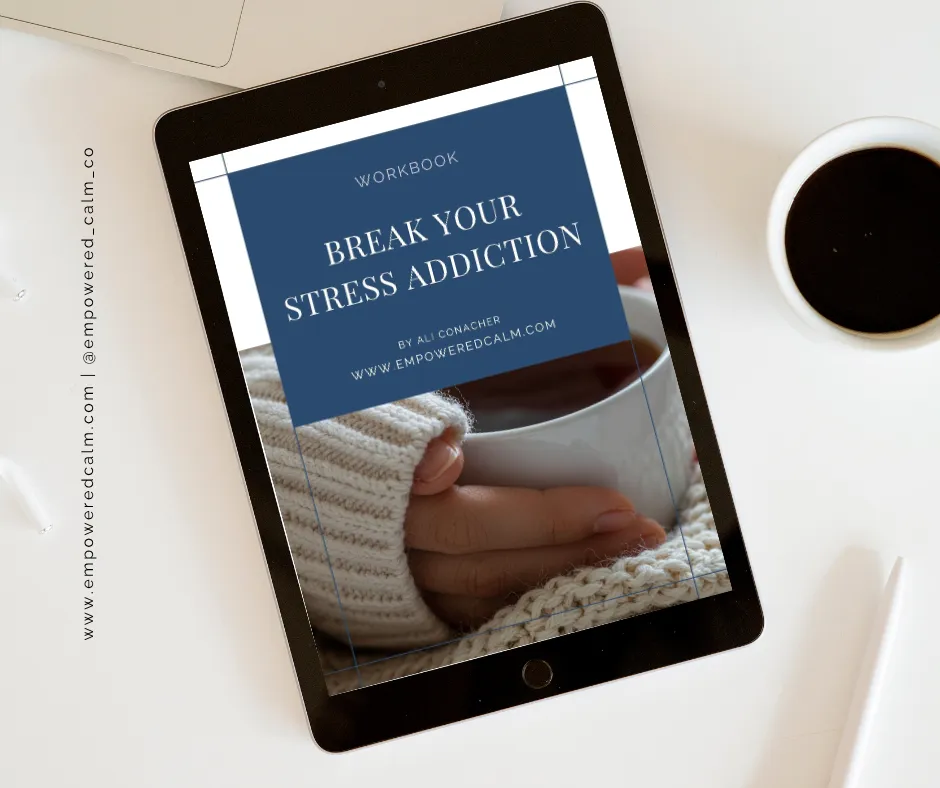
If you have recognised anything in yourself here and want to go deeper, I have put together a workbook called Break Your Stress Addiction which takes you through all of this in more depth.
Inside you will find out more about why your nervous system adapts to stress the way it does, some down-regulation tools for when you are wired or overwhelmed, some up-regulation tools for when you are feeling numb or shutdown, a 6 step framework for breaking the stress cycle and some journaling prompts to help you process the work.
You can purchase it here for just £12. https://empoweredcalm.com/break-your-stress-addiction-workbook
If you would like the understand more about where your nervous system is right now, you can take my free quiz: https://empoweredcalm.com/quiz
A calmer version of yourself is not as far out of reach as they feel.